 EN
EN

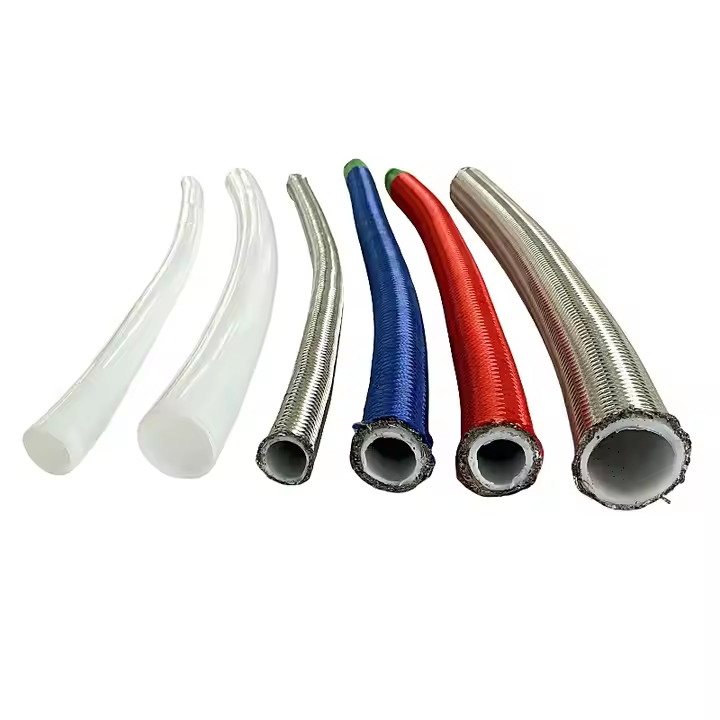
What is the temperature resistance range of Teflon tubes?
Teflon tubes handle heat really well, with regular PTFE versions working continuously from around minus 200 degrees Celsius all the way up to plus 260 degrees Celsius. The 2024 Fluoropolymer Performance Report backs this up. These temperature ranges make them great for some pretty tough situations, like dealing with liquid nitrogen on one end and hot automotive exhaust systems on the other. Some special types can even keep their shape when temps drop below minus 250 degrees Celsius, although they get stiffer in those super cold conditions. For brief periods, these tubes can actually take heat shocks up to 300 degrees Celsius without breaking down much. That's why we see them used so often in aerospace applications and chemical plants where occasional bursts of intense heat happen during normal operations.
How PTFE’s molecular structure enhances thermal stability
PTFE has amazing heat resistance because of those super strong carbon-fluorine bonds that take about 487 kJ per mole to break, one of the toughest numbers in all of organic chemistry. What makes this material so special is how its molecules hold up against high temps. But here's something interesting: even though these bonds are so strong, there are actually pretty weak attractions between the polymer chains called van der Waals forces. This lets PTFE stay flexible when things get really cold, avoiding cracks and fractures that would normally happen with other materials at low temperatures. And speaking of temperature extremes, the thick layer of fluorine surrounding the carbon structure acts like a shield. It basically locks down molecular movement when heated and keeps oxygen from getting through, which slows down the aging process that happens when materials oxidize over time.
Factors influencing performance under extreme heat and cold
- Thermal degradation rate: Extended exposure near 260°C accelerates bond weakening
- Mechanical loads: Tensile stress increases creep risk above 200°C
- Exposure duration: Long-term service gradually reduces molecular weight
- Chemical environment: Aggressive solvents may plasticize PTFE at elevated temperatures
Combined stresses—such as contamination and thermal cycling—can reduce performance. For instance, contaminated tubes show 23% faster diameter expansion than clean counterparts under cyclic conditions. Effective design mitigates these effects through safety margins, optimized wall thickness, and protective shielding to ensure reliability in critical applications.
High-Temperature Performance and Degradation Thresholds
Maximum Continuous and Intermittent Operating Temperatures of Teflon Tubes
PTFE tubing can handle temperatures ranging from as low as minus 200 degrees Celsius all the way up to plus 260 degrees Celsius without issues. For short periods, some industrial applications allow going even higher, around 300 degrees, though this isn't recommended for long term operation. When exposed to heat beyond 260 degrees for extended periods, the material starts breaking down slowly over time. But within its normal temperature window, PTFE stands head and shoulders above regular rubber seals and beats most other special plastics too. That kind of thermal stability is why engineers specify PTFE for critical parts in jet engines and for pipes in chemical plants where materials need to maintain their shape and strength despite extreme heating cycles day after day.
Thermal Degradation and Oxidative Stability at Elevated Temperatures
When temperatures go over 300 degrees Celsius, PTFE starts breaking down. This means it releases harmful gases and basically falls apart structurally. The good news is that those strong carbon-fluorine bonds give PTFE much better protection against oxidation than regular plastic materials made from hydrocarbons. Still worth noting though, if something keeps heating up past 200 degrees repeatedly, we see around a 40% jump in creep deformation when these materials are under stress. Polymer scientists have studied this for years now, tracking how different materials age over time with temperature changes.
Comparative Analysis: PTFE vs. Other Fluoropolymers in High-Heat Applications
| Material | Max Continuous Temp. | Key Thermal Limitation | Common Industrial Use Cases |
|---|---|---|---|
| PTFE | 260°C | Degradation above 300°C | Exhaust systems, semiconductor furnaces |
| FEP | 200°C | Melting point distortion | Lab equipment, low-pressure tubing |
| PFA | 260°C | Higher cost vs. PTFE | Lined chemical tanks, steam tracing |
While PFA matches PTFE’s temperature resistance, it lacks equivalent high-temperature mechanical strength. FEP’s lower thermal tolerance restricts its use in demanding fluid transfer applications.
Flexibility and Brittleness of Teflon Tubes at Sub-Zero Temperatures
PTFE stays flexible even when temperatures drop as low as minus 196 degrees Celsius or about minus 320 Fahrenheit. The material starts to get brittle gradually as it approaches these extreme conditions rather than failing all at once. Because PTFE has this semi crystalline structure, it doesn't just snap under stress like some materials might. Tests show that impact resistance is still around 85 percent of what we see at normal room temperatures when things get down to minus 100 degrees Celsius according to ASTM standard D256. For applications where walls are really thin less than one millimeter thick there's actually improved flexibility in cold environments. But these thinner sections need special attention regarding how they handle repeated stresses during operation in those super cold settings.
Performance Data: PTFE in Liquid Nitrogen (-196°C) Environments
Testing shows PTFE withstands over 500 thermal cycles between 25°C and -196°C without cracking or dimensional change. Dielectric strength holds steady at 400 V/mil in liquid nitrogen, making it highly effective for cryogenic electrical insulation. This resilience is attributed to the preservation of carbon-fluorine bonds under severe thermal stress.
Design Considerations for Cryogenic Sealing and Flow Systems
At -200°C, PTFE contracts linearly by 1.8%, necessitating engineered interference fits for reliable seals. Its inherent lubricity minimizes galling in cryogenic valves and joints, especially when surface roughness stays below 0.4µm Ra. Designers must balance compression levels (typically <25%) against thermal gradients to prevent leakage from cold flow.
Critical Industrial Applications in Extreme Thermal Conditions
Aerospace and automotive uses: Teflon tubes in engines and exhaust systems
PTFE tubing performs reliably from-200°C to +260°C, making it essential for aircraft fuel lines and automotive exhaust sensors. In jet engines, it withstands transient temperature shifts exceeding 300°C while resisting deformation and maintaining compatibility with aviation fuels.
Chemical processing and oil & gas: PTFE under cyclic thermal stress
Industry data indicates PTFE tubing endures50,000+ thermal cyclesin refinery heat exchangers operating at 240°C. This durability arises from its molecular inertness to acids and hydrocarbons, coupled with minimal thermal expansion—about 100 times less than PVC—ensuring dimensional stability.
Semiconductor manufacturing: Thermal cycling and material purity demands
Ultrapure PTFE tubing ensures contamination-free transport in wafer etching systems exposed to1,200°C process environments, shedding fewer than 0.1 ppb particulates. Its non-stick surface also simplifies cleaning in plasma-enhanced chemical vapor deposition (PECVD) chambers.
Balancing chemical resistance with thermal creep in dynamic systems
Although PTFE surpasses nylon and polyethylene in chemical and thermal performance, engineers account for 0.5% creep strain under sustained loads at 200°C. Reinforcement strategies include:
| Solution | Effectiveness (200–260°C) |
|---|---|
| Carbon-fiber braiding | Reduces expansion by 40% |
| PFA inner liners | Lowers friction loss by 25% |
Process control studies confirm that reinforced Teflon tubes maintain seal integrity in600+ PSI steam lines across pharmaceutical reactors and geothermal energy installations.
FAQ Section
What is PTFE tubing?
PTFE, commonly known as Teflon, tubing is a plastic polymer used in various applications due to its excellent thermal stability, chemical resistance, and non-stick properties.
What temperature range can PTFE tubing withstand?
PTFE tubing is highly resistant to extreme temperatures, withstanding continuous exposure from -200 to +260 degrees Celsius. It can endure brief temperature shocks up to 300 degrees Celsius.
Where is PTFE tubing typically used?
Due to its thermal and chemical resistance, PTFE tubing is often used in aerospace applications, automotive exhaust systems, chemical plants, and semiconductor manufacturing.
How does PTFE perform at cryogenic temperatures?
PTFE retains flexibility at sub-zero temperatures and can endure over 500 thermal cycles without cracking, making it suitable for cryogenic applications.
Table of Contents
- What is the temperature resistance range of Teflon tubes?
- How PTFE’s molecular structure enhances thermal stability
- Factors influencing performance under extreme heat and cold
-
High-Temperature Performance and Degradation Thresholds
- Maximum Continuous and Intermittent Operating Temperatures of Teflon Tubes
- Thermal Degradation and Oxidative Stability at Elevated Temperatures
- Comparative Analysis: PTFE vs. Other Fluoropolymers in High-Heat Applications
- Flexibility and Brittleness of Teflon Tubes at Sub-Zero Temperatures
- Performance Data: PTFE in Liquid Nitrogen (-196°C) Environments
- Design Considerations for Cryogenic Sealing and Flow Systems
- Critical Industrial Applications in Extreme Thermal Conditions
- FAQ Section